Wednesday, May 25, 2011

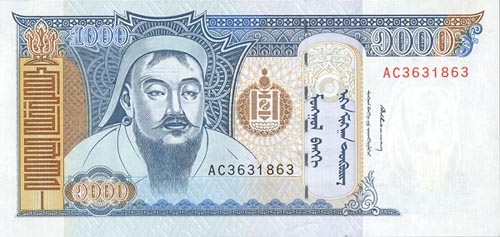
Genghis Khan Lives

Just look at that face- It's easy to be impressed by the stern, resolved stare. He conquered most of the "known world" from Korea to Europe, leading an army of invincible horseman. But when he got to the Great Wall that was protecting China, the story is that he played smart and simply bribed the guards. John Wayne played him in the movies! (I read somewhere recently that Mickey Rourke is playing him in an upcoming film - I will pay good money to see THAT.)


The modern Mongolians are rightfully proud and have named just about everything you can think of after him. Airports, candy bars, condo projects, several brands of vodka - you name it.
When I first visited Mongolia in 2008, I opened my hotel drapes and found him staring in my window. He looks quite pleased with the new surge in construction that was underway.


If I am reading the legend on this map correctly, most of this territory was conquered within an amazingly short 50 years.

Sunday, May 22, 2011

Ancient Horses

A little more than seventeen thousand years ago, someone entered a cave in what is today southern France. Their hands were full of brushes and pigments and their mind was fixed on the image of an animal that had captured their imagination. By the light of a fat burning lamp a few simple strokes were applied to the cave wall and preserved the memory of that horse for us to see today. The cave at Lascaux is full of images that might have been painted yesterday but many of the animals shown now are extinct. The wild horses on the cave wall are nearly extinct too - modern horses have evolved through centuries of our human management. 

But in Mongolia, there are about 250 descendants of this ancestral horse who roam freely. It is highly unlikely that we will be anywhere one of the wild herds of Takhis, as the Mongolians call them, but it's nice to know they will be there.

Friday, May 20, 2011

Don't Call Them Ponies

My interest in traveling across Mongolia on horseback for a week was tempered by the fact that I had never ridden before. Needing to set that straight, I have been riding once a week for the past couple of months at a local equestrian center in Lakewood. So far so good - I am enjoying the experience, although there is more physical conditioning than I would have thought. Lately I have been riding Lady Bird who is a bit overweight and needs the exercise as much as I do. She is a sweet horse but sometimes my encouragement is not enough to keep her in a trot. At this point I am feeling pretty comfortable - meaning I don't think I will be embarrassed (or injured) on the trail, but I still have a lot of ground to cover in my lessons - like maybe learning something faster than a trot.
I have learned that Mongolians tend to maintain an attitude different than ours towards their horses. They keep the herd wild, and rotate the animals that they will ride. After a period as a working horse, that are returned to the herd. No names for individual horses, and they only approach them from the left side for mounting - keeping one side of the animal "wild". (Do NOT approach from the wild side.)

Mongolian horses are much smaller than American horses, but DON'T call them ponies. Horses and riders are both a bit touchy on the subject.

Wednesday, April 27, 2011

From the Flag - Mongolia

I am always interested in the significance of a country’s flag – it says a lot about how people view themselves. The focal point of the Mongolian flag is the Soyombo and here is what Wikipedia has to say – (some of this is quite poetic):

“The Soyombo symbol is a special character out of the Mongolian Soyombo script. It serves as a national symbol of Mongolia, to be found on the Flag of Mongolia, the Coat of arms of Mongolia, and on many other official documents.
The elements in the symbol are given the following significance (from top):
  • Fire is a general symbol of eternal growth, wealth, and success. The three tongues of the flame represent the past, present, and future.
  • Sun and moon symbolise that the Mongolian nation will exist for eternity as the eternal blue sky.
  • The two triangles allude to the point of an arrow or spear. They point downward to announce the defeat of interior and exterior enemies.
  • The two horizontal rectangles give stability to the round shape. The rectangular shape represents the honesty and justice of the people of Mongolia, whether they stand at the top or at the bottom of society.
  • The arga-bilig (Yin-yang) symbol illustrates the mutual complement of man and woman. In socialist times, it was alternatively interpreted as two fish symbolizing vigilance, because fish never close their eyes.
  • The two vertical rectangles can be interpreted as the walls of a fort. They represent unity and strength, relating to a Mongolian proverb: "The friendship of two is stronger than stone walls."