Tuesday, July 30, 2013

Deadhorse

July 29th
The end of the Dalton Highway is Deadhorse and the Prudhoe Bay oil fields.  Miles and miles of mud roads, heavy equipment, mobile drill rigs, storage warehouses, and rugged housing modules; all in support of the 1,100 oil wells grouped in clusters strewn for 70 miles across the tundra.  I am stunned by the extent of the place.  It is a really ugly landscape, but you can't help but admire the audacity of it and my initial depression on seeing it gradually gives way to acceptance.  Small groups of caribou wander between buildings and vehicle storage yards, mostly oblivious to man's rape of their landscape. The weather today is cool and windy, in the 40's. Officially a desert with about 7 inches of precipitation a year, there is still mud everywhere - the ground does not drain due to permafrost below. Road graders prowl the muddy streets, fighting a war with the potholes. Winter conditions are extreme but work continues through the year. We arrive at our accommodations in a utilitarian worker's housing structure and remove our shoes after passing through an airlock mud room. Meals are hardy and the workers are burly and heavily clothed but some wear baby blue boot covers in the hallways instead of removing their boots. We settle in and take advantage of the common toilet, shower and laundry room, although the women wait their turn for the smaller ladies facilities. No keys for the doors but theft is not an issue in such a place; residents have greater worries.
We visit the only store for hundreds of miles - a combination of a huge hardware store and post office, with a general store upstairs. Alicia visits the post office to inquire about shipping a caribou antler she found on a hike behind Galbraith Lake. But the post office lady checks with the airline and confirms it can be carried on if the tips are protected, so she helps with wrapping in pink bubble wrap, and grabs her camera to take a picture of Alicia in front of the store.
The day we arrive happens to be a special day: sunset. The sun has been up continuously during the summer, but today its low arc will dip below the horizon for about 20 minutes. I set my alarm and wake to capture the event and am rewarded only by a soft pink glow through the clouds to the north.
Our last day begins with a bus tour conducted by an informative security contractor who escorts us into areas closed to the public. He tells us that the tandem bike riders that we met in Coldfoot had been on the tour yesterday and we are happy to hear they made it to the end of the road safely.  When we reach the end of the tour at the Arctic Ocean, we gladly participate in the ritual of taking a dip. I have brought my bathing suit, but it is so cold and windy that we all just roll up our pants and wade in, keeping our balance on the gravel in the small surf. Air and water temperature are both about 45,  so the photo session is short but we perform a group chorus line to commemorate the end of the trip. 


North Slope

July 27th
Along the way people told us what to expect as we go further north.  Above the Brooks Range, expect the weather to be different (it is)  and expect more mosquitoes (there are).  Before we leave trees behind for the rest of the trip, we stop to collect firewood to tie to the top of the van. We soon work our way through the pass, deferring to eighteen wheelers who need a  lot of the unpaved road on the turns.  Arriving at Galbraith Lake, a light rain and a bit of wind makes setting up camp a little trying. We are beginning to see the footprint of the oil industry on the North Slope; first in passing Pump Station Four with its industrial buildings and workers housing, then a large gravel quarry used for nonstop highway maintenance during the summer, and finally by the presence of a temporary workers housing at our campsite, complete with 24 hour generator noise. Mosquitoes are much more plentiful here and I spend much of the time in a headnet. The small good news is that they are not very fierce, but I still have a lot of bites. We are north of the last tree and had made a stop along the way to gather firewood to tie to the top of the van. Smoke seems to keep the mosquitoes at bay. After dinner of reindeer sausage,  scalloped potatoes and fresh salad from the Wiseman trapper's garden, the rain settles in for a steady soaking lasting through our next morning's chilly, windy hike up the valley system behind our camp.


Brooks Range

July 25th
The weather is stunningly clear and we fill the daylight hours with activities. We visit the settlement of Wiseman and are toured around by Jack,  one of the year round residents who lives off the land, with garden in summer and hunting in winter.  He is an encyclopedia of history, natural cycles, hunting and survival. He is direct, articulate, and personable - but a bit intimidating; he does not stop talking for two hours.  We eat lunch back in camp and head to Coldfoot truckstop for laundry,  showers,  and dinner.  After dinner we fly to the native village of Anaktuvak, touring the Brooks Range from above -  no road access in northern Alaska except the Dalton Highway.  Returning from a walk at Coldfoot before our 8:00 pm flight, Lisa and I are surprised to meet the man and woman with a tandem bike that we saw twice along the road from Fairbanks.  They have an interesting story,  to say the least.  They started at the tip of South America on a trip to promote awareness of blindness and to encourage persons with disabilities - they are both legally blind, with limited vision.  The rough part: their bike has mechanical difficulties that cannot be repaired here and they have decided to push on by hitching the rest of the way to Prudhoe Bay.  I would be thunderstruck, but they are both upbeat and happy to share their story.
Our pilot lands at the airstrip on time and  we fly 40 minutes to Anaktuvak, the home of the Nunavut people who were the last group of indigenous people in North America to give up their lifestyle and settle in a permanent community.  Oil exploration is a large reason.  We are shown around by Darryl, an articulate young man with a nice manner and large smile. The village is largely modern housing scattered on a side slope of a stunningly beautiful valley that remains a main caribou migration route. We make it back to our camp by 11:00 pm and there is still daylight to burn for a Frisbee game with plastic gold panning plates. 


Hiking on Tundra

July 24th
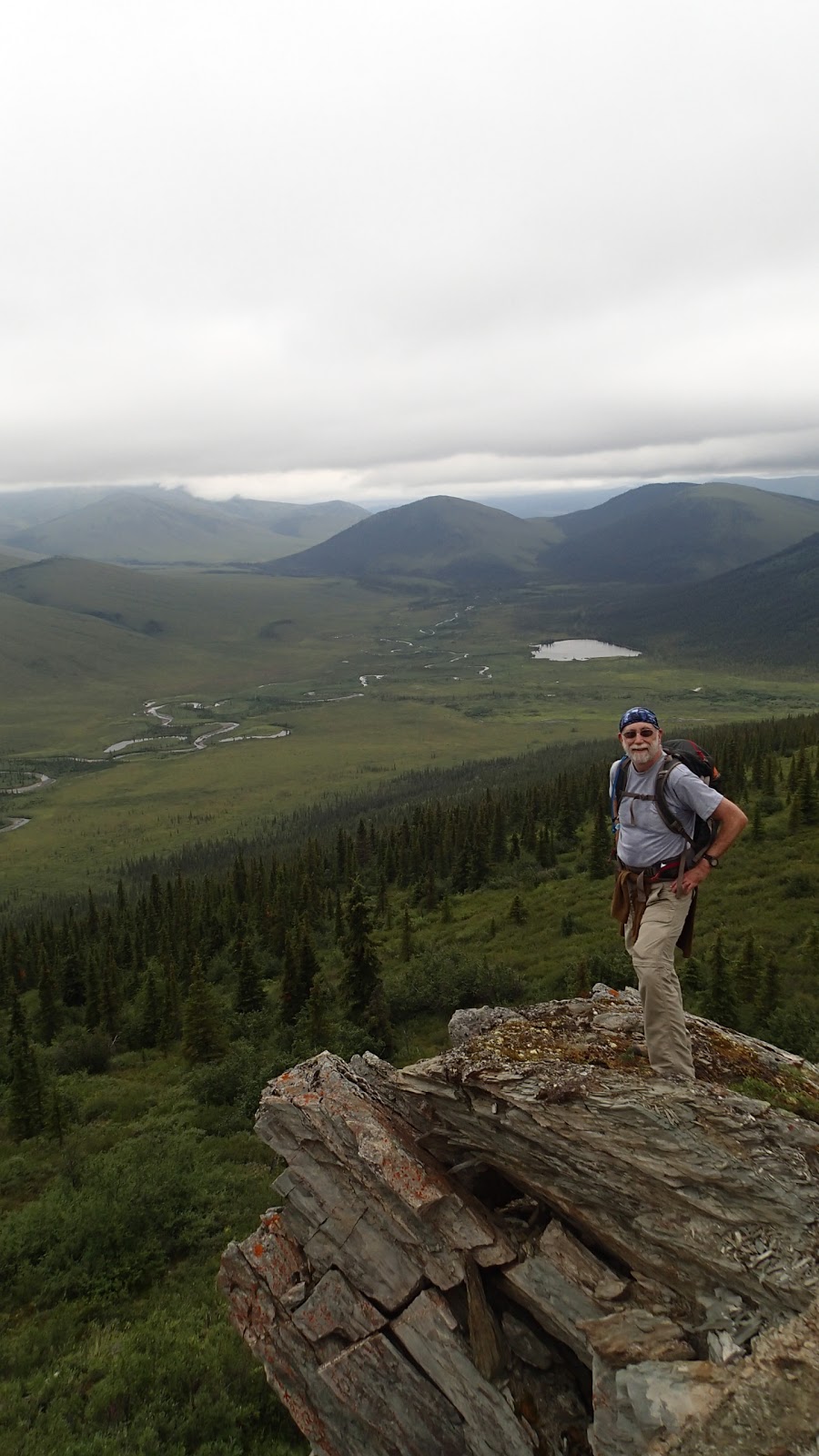
The Brooks Range is the northernmost extension of the Canadian Rockies and it bends east to west across Alaska above the Arctic Circle. We camp several days on the south slope of the range and will camp several more on the north slope. This morning we wake up in the Marion Creek campground near the Gates to the Arctic National Park.  We are nearly alone in the campground. They are still working on repairing the campground water supply; damaged by frozen pipes last winter.  Daily run back to Coldfoot for our water.  After breakfast we mobilize to climb Midnight Dome, a tundra covered hill north of here. Hiking on tundra is a strange experience.  A spongy mesh of grass, shrubs and moss is continuous up the hill. The ground is not suitable for trails, so we pick our way crosscountry. It is tough walking because it compresses maybe eight inches each step. So climbing is like a stairmaster with vertical progress much reduced.  We trudge maybe two miles and 1,100 vertical feet to a great overlook over the valley and stream below. During the lunch break the weather closes in and a light rain starts.  We head down, stopping to pick blueberries along the way.  Maybe blueberry pancakes in the morning tomorrow. When we get to the bottom, we are pretty wet and ready to get back to camp.