Wednesday, January 30, 2019

The More Things Change...


Today, I looked back and saw that it has been nearly three years since I last visited Cuba - in February of 2016. I think a lot has changed, but much remains the same. I just landed in Cuba and soon will be visiting Havana as well as new locations in the western tobacco growing countryside as well as colonial towns in the center of the country. I'm here with photographers sponsored by Santa Fe Photographic Workshops and led by Arthur, Kip and Jennifer, as well as talented Cuban photographers Carlos & Jorge.

Back in 2016, there was optimism about President Obama’s efforts to “normalize” relations, Fidel Castro was alive, and his brother Raul was president of the country, but repressive laws remained on the books - even if most Cubans found a way around them. On the positive side, the country was having difficulty keeping up with the surge in tourism and Cuban citizens were scrambling to find a way to capitalize through small restaurants, apartment rentals, or just about anything they could think of. Foreign investors were putting money into badly needed building renovations, and for the time at least, the Cuban people were happy to see American visitors.

A lot was happening then, and quickly.

Today, both the US and Cuba have new presidents, and future relations are uncertain. Most of the US diplomats have withdrawn from Havana due to the “brain wave” thing, but US commercial airline flights are now allowed and cell phones from the US (may) work in many parts of the country. Visits by US citizens are still permitted, but rules have reverted to a time when access was more controlled. I have a few forms and a visa for travel that I need to carry, and the Cuban government adds a surcharge to my plane ticket to cover medical insurance. On a hopeful note - last month, Major League Baseball has just reached an agreement with the Cuban baseball authorities to allow Cuban players to sign contracts with US teams without defecting, and allow return travel to Cuba by those players (I think this is a positive development, but there's still a strong possibility that the deal will blocked by the US government).

And recently, Cuba has drafted a new constitution to be voted on by the people in February. When it passes (I can’t imagine that it wouldn’t) changes will not be earth-shattering; Cuba will remain a single party communist government and will continue to control major industries – manufacturing, sugar, mining, tobacco, rum, etc. – but changes allowing private ownership of property and business will be adopted. There will even be age limitations on the presidency – no older than 60 to initially occupy the office. Worth noting that the current president, Miguel Díaz-Canel, is 58 and is eligible to be (re)elected by the Assembly under the new constitution. He sounds pretty bland in the Wikipedia  description as "a party technocrat who was little-known to the public before becoming president. Policy experts expected him to pursue cautious reform of his predecessors' economic policies, while preserving the country's social structure."

So, a lot is happening now, but a little slower.

I look forward to seeing what's up for myself in the next weeks.


Sunday, January 20, 2019

Discoveries Close to Home

It's a beautiful day for an adventure close to home. I’m driving west from downtown Long Beach - ahead is the huge combined Port of Los Angeles + Long Beach and I am heading to explore it with my grade school buddy, Tom. The port is actually so close that I can see every day from my window, and I normally have no cause to go there, but we hope for new discoveries. I have a few high tech sites I hope to explore, but we will probably just do a lot of wandering. We drive towards Terminal Island and the route's a bit convoluted by detours around the construction of a new bridge to replace the existing bridge that is too old (only 1968), too narrow, and too low for the next generation of cargo ships - a huge project.

Making our way out of the construction zone, we turn off into the port and come across a huge white tent structure surrounded by fences and razor wire – it is the temporary home of the audacious project by SpaceX (Elon Musk) to build a huge starship for sending people to Mars. We drive in circles through the parking lot and I would love to peek inside but we see the guarded entrance and decide to continue on our way. Now we're driving on the Navy Mole, a large man-made peninsula that sheltered the former LB Navel Shipyard and we're between the waterline and an endless siding of train cars loaded with thousands of cargo containers on their way to who knows where. We stop for pictures and to soak up the sun.


At the end of the road is the now quiet home of the Sea Launch floating rocket launching platform – someone’s crazy, but once successful, idea to float rockets down to the equator in the middle of the Pacific Ocean for a better angle to launch communications satellites. It is quiet right now because after financial problems, I think it has been sold to a Russian company and they are gearing up to continue operations next year. Interesting.


It is Saturday but there is still truck traffic on the roads, but few cars. I keep wondering if we're somewhere we shouldn't be and I keep glancing in the rear view mirror to see if we are being tailed by port security, but almost all roads are open to the public. Areas that are off limits, and there are quite a few, are protected by security gates and guards - Coast Guard station, shipping company yards, water treatment plant, oil storage tanks and the like - even a federal low security prison. As we drive, Tom and I are sharing rambling memories of youthful exploits, catching up on what old classmates are doing, and sometimes moving on to our feelings about ageing and death. A lot to consider, but the conversation is easy going and often interrupted by discoveries along the way.

Along the way, in the middle of the busy port, we come across a small memorial and statue commemorating the site of a fishing village that was inhabited by Japanese Americans before WWII. At the start of the war the residents were removed from their homes and relocated to internment camps - the village bulldozed when the government took over the land. Recently, someone has placed fresh flowers. We see there are two other people here – a man and his wife, visiting from Chicago to celebrate her mother's 90th birthday, and I offer to take their picture. We chat a bit and they tell me that they came across the memorial by chance and they share the story of his parents who were relocated to a camp in Arkansas during the war. Some of his relatives moved west after their release by his family stayed in the Midwest. A poignant connection.

Moving on, I am looking for another spaceship venue that I had heard of but we discover that the SpaceX rocket landing platform, brilliantly named “Just Read the Instructions” after a sci-fi spaceship, is apparently not in port. Or maybe I am just lost. I had hoped to see it because it is an amazing project allowing rockets to be reused by returning and landing, Buck Rogers style, off the coast of Vandenberg Air Force Base. Instead, we see a gull watching a giant cargo ship being nudged towards the outer harbor by two tugs.


Soon, we come across a Los Angeles Fire Department fire boat station near the battleship USS Iowa, and we all the doors are locked but we can peak through windows into its shelter. It is quite a machine and we can see a few people in the pilot house, maybe having coffee. The boat’s main water cannon proudly boasts that it can furnish 11,000 gallons of water per minute. I do some mental division by 60 to get seconds and I am duly impressed.

On the way home, we stop at the Queen Mary in hopes of joining a tour of the engine rooms. Only a few problems – the tours are booked up until three hours from now, and the cost is $45 to even get on board. Disappointed, we look up at the side of the ship and imagine the effort it took to drive the thousands of visible rivets that hold it together.

A rewarding day, but I think we have just scratched the surface. I get home and look up information about the port and discover that the port of LA is the largest container port in the US and the LB port is second largest. But another remarkable fact is that the two of them combined only make up the 9th largest port in the world (ahead of them are ports in Singapore, South Korea and SIX from China, including #1 Shanghai which, on its own, handles almost three times the traffic of LA/LB). Food for thought.

Thursday, August 2, 2018

In Camp - Zambia


A gentle “good morning, good morning” wakes me; it is 5:30 and someone is filling the washbasin outside my tent. I am up, find my headlamp, find the clothes that I wore yesterday next to the futon bed and unzip the tent to splash warm water on my face. A visit to the pit toilet, and then join the others for breakfast.


The last several days have a comforting routine –
up at 5:30, breakfast of porridge and toast, leave for a walk at 6:15, stop for tea at 9:30, return to camp for a remarkable lunch at 11:30, siesta until 3:30 tea, leave for a walk at 4:00, stop for sundowner drinks at 6:30, return for a remarkable dinner at 7:30, in bed by 9:00. The meals are all made in camp from scratch over a wood fire, including baked bread, muffins and cookies in a ground oven. It is a mobile camp and will to pack up and move to the next campsite during our morning walk.


When we leave for today’s walk, we are with our guide, Jason and support team of Jimmy – the armed park ranger who is responsible for keeping us safe, and Geoff, - the camp naturalist guide who is also “tea bearer”. Our path varies from woodland to tall grass as we follow game trails near the bank of the Mupamadzi River. Jason is a native Zambian whose European parents came to the country in the 1950’s. Along the way, he is prone to say things like: “So, should we go around here and see if we can catch up to the lions?” or “The elephant hasn’t noticed us yet because we are downwind, but we don’t want to startle him, so if he gets any closer let’s hope he goes behind that bush so we can withdraw.” But mostly the walk is “Things seem pretty quiet just now.” and we observe a lot of birds, plants and small antelope. There are signs of wildlife everywhere – vultures on a kill in the middle of the river (maybe wild dogs?), roaring lions and irritated elephant trumpets in the distance, lion, leopard, hyena & elephant tracks, or monkey alarm calls from the trees (leopard nearby?), but mostly everything seems intent on avoiding us.


We stop for tea and freshly baked peanut cookies along the bank of the River and notice a small group of Cape Buffalo in the distance, on the far bank and decide to explore. The river is knee deep, cool, with a sandy bottom, so not a good habitat for crocodiles who like deep murky water, so that’s good to know. But there is a bit of a current, so I have to concentrate to keep my balance.


On the other side of the river we approach the buffalo from downwind, but they soon see us and act warily until they figure out our intent. In fact, everything in this remote part of South Luangwa National Park is a bit skittish because our camp has the only humans for maybe 50 miles and they are just not used to us. Every animal has a natural safety zone, and with the buffalo we cannot get within maybe 100 yards before they retreat. Jason’s experience has led him to believe that all the wildlife is rational and not necessarily a threat – except for the psychotic ones, which he tells us to supposedly be reassuring. In 30 years he has only heard for a handful of cases where a warning shot had to be fired to head off a bad encounter.


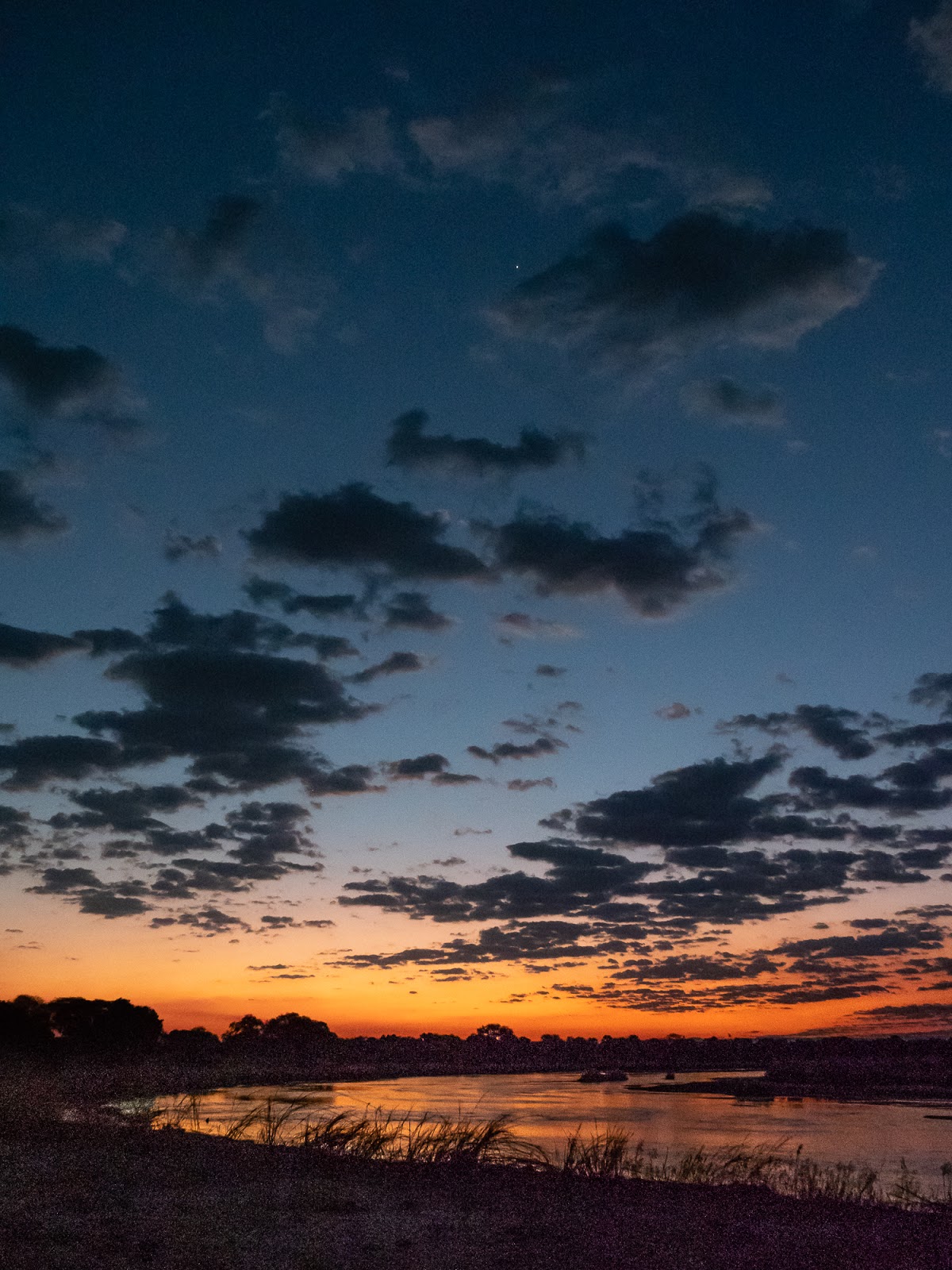
Following afternoon tea and fresh muffins, the second walk of the day is mostly a stroll with ample time to look back at the developing sunset. We end up on a bluff over the river where the camp vehicle has brought our setup for cocktails and fresh brochetta. When the sun is down, it is easy to spot Venus, Mars, Jupiter, and Saturn in addition to the Moon. Mercury is up there somewhere, but may be behind a cloud. 


Monday, July 16, 2018

Deep Planning for Zambia


I am getting ready for travel to Zambia tomorrow and I'm taking a moment to reflect on process. I have always known that I get extremely involved with planning details leading up to a trip: making lists, pulling out old gear and buying new gear, charging batteries, counting pills, looking over Google Earth, or weighing boots. This behavior always worried me a bit, but I have found a way to make it feel acceptable – I will call it Deep Planning. I like this name because it sounds purposeful, rather than unhinged.


Right now, I'm going through a final checklist:
  • Crisp new US cash, which is accepted if I choose not to convert to Zambian Kwacha - check
  • Notify credit card companies about travel - check
  • Buy new super glue - check
  • Emirates Airline check in - check
  • Put mail delivery on hold - oops, better do that now

I've never been to Zambia and we will be spending all of our time in South Luangwa National Park, in the eastern "lobe" of the country. This trip promises to be a bit different from some previous trips. On other visits to southern Africa, the guides make a point of making sure that you do not get out of the Land Rovers if "wildlife" is nearby - I guess that makes sense for all the obvious reasons. This trip: a little different - we will include walking safaris from one tented camp to another, with five miles or so of wildlife in between. This is a main offering at the park, and is done all the time. Even so, it might just be a little nerve rattling, even with the armed ranger along but I'm looking forward to it. I hope I am able to update this journal along the way, but I don't expect any cell coverage in "the bush".
I see from old maps that David Livingstone also walked the area in the 1860's - and his heart lies buried under a tree less than a week's walk to the northwest from our camps.